
Senhor Santo Cristo dos Milagres: A Guide to the Azores’ Most Iconic Festival
Every year, the Atlantic breeze in Ponta Delgada carries the scent of incense and fried dough. It’s the time of Santo Cristo—the second-largest religious festival in Portugal and the beating heart of Azorean identity. Whether you are a pilgrim or a curious traveler, this is the Azores at its most vibrant.
Table of Contents
Faith, Flowers, and Fire: The Magic of Senhor Santo Cristo dos Milagres
At Flowtours, we believe travel is about more than just sightseeing; it’s about feeling the pulse of a culture. There is no better time to feel the pulse of São Miguel than during this 400-year-old tradition.
In this guide, we’re diving deep into the history, the hidden gems, and the practical tips you need to experience the “Miracle” like a local.
The Sacred Image: A Masterpiece of Faith
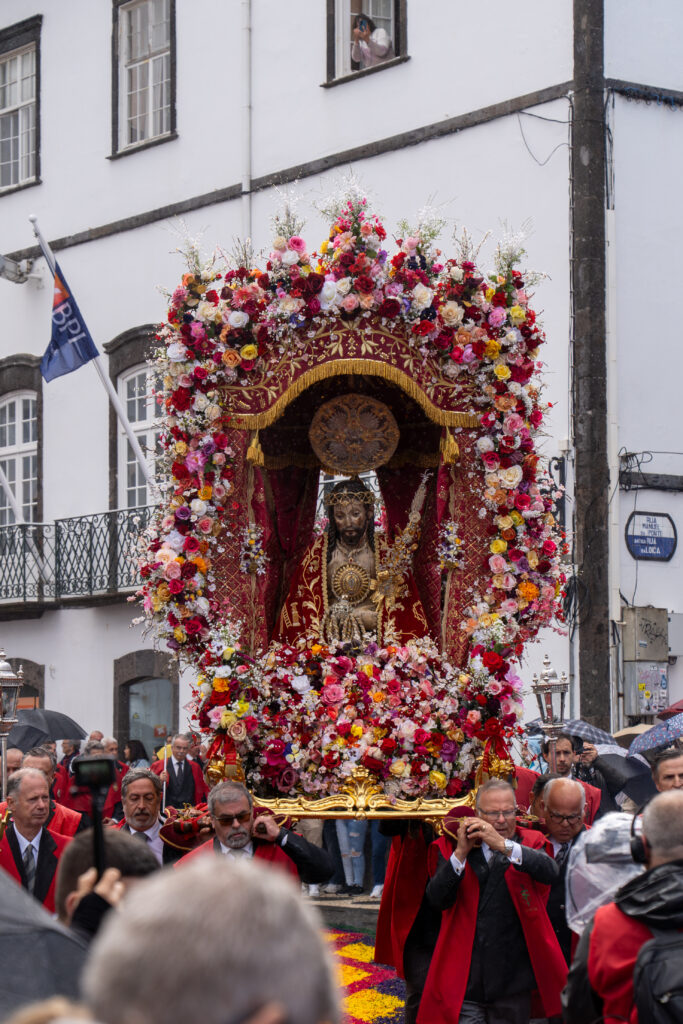
The center of the festival is the image of “Ecce Homo”—a 17th-century wooden bust representing Jesus Christ during the Passion. But this isn’t just a statue; for the people of the Azores (and the massive diaspora in the US and Canada), it is a living symbol of hope.
The image is kept year-round in the Sanctuary of the Convent da Esperança. When you see it, look closely at the eyes—devotees claim the gaze follows you regardless of where you stand in the chapel.
The Legend: From Pirate Raids to Miracles
The story began in the 16th century at the Caloura Convent.
The year was 1540. The rugged cliffs of Caloura stood as silent sentinels over the Atlantic, sheltering a small community of nuns at the Monastery of Vale de Cabaços. In those days, the horizon was a source of constant anxiety; the sails of pirate ships often signaled fire and theft.
During one such raid, the nuns were forced to flee to the safety of Ponta Delgada, leaving behind their sanctuary. But the sea, which had brought the invaders, was about to bring a miracle.
Legend tells of a heavy, salt-crusted wooden crate that appeared bobbing in the surf near the monastery’s jagged rocks. When it was pulled from the tides and pried open, the villagers didn’t find spices or gold. Instead, they found the Ecce Homo—a wooden bust of Christ, his expression frozen in a look of profound, haunting peace. The crate had likely fallen from a ship under attack, yet the image remained miraculously dry and unscathed.
The Earth Shook, and the World Stood Still
For nearly 150 years, the image sat in the quiet shadows of the Convent of Our Lady of Hope. But in 1700, the island of São Miguel began to scream.
Violent, relentless earthquakes tore through the ground. Stone walls crumbled like sand, and the people lived in a state of perpetual terror, sleeping in the open fields as the earth refused to stop shaking. It was then that a humble nun, Mother Teresa da Anunciada, had a vision: the “Lord” needed to walk among his people.
On April 13, the nuns carried the heavy statue out of the convent and into the trembling streets. The air was thick with dust and desperation. As the procession moved through the city, a sudden, violent jolt caused the statue to slip from its litter and fall to the ground.
The crowd gasped, falling to their knees. But at that exact moment—the moment the wood touched the Azorean soil—the earth went silent. The tremors stopped instantly. The sky cleared.
Since that afternoon, the people of the Azores have never forgotten. Every year, they return to the same streets to walk the same path, ensuring that the “Lord of the Miracles” never has to walk alone again.
The Treasure : gold , Rubies and Devotion
One of the most mind-blowing aspects of the festival is the Treasure of the Lord. Over centuries, devotees have donated jewelry as “promises” for miracles granted.
The Scepter: A 17th-century masterpiece of gold and precious stones.
The Crown of Thorns: Crafted from solid gold and encrusted with rubies and emeralds.
The Capes: The statue wears a red velvet cape hand-embroidered with gold thread. There are dozens of these capes, some weighing over 50kg due to the amount of gold and jewels stitched into them.
Long before the festivities begin, the heart of the Diaspora reaches back to São Miguel as a devoted pilgrim offers a new red cape to the Lord—a symbol of gratitude, sacrifice, and a connection that spans oceans.
Anastacia Dias - Azorean Local
The Gift of the Cape: A Thread Between Two Worlds
While the lights and the crowds capture the world’s attention, one of the most intimate traditions happens behind the closed doors of the Convent of Esperança. Every year, a new, magnificent Red Cape is offered to the image of Senhor Santo Cristo dos Milagres.
This isn’t just a garment; it is a profound gesture of gratitude from the Azorean Diaspora.
A Vow Sewn in Gold
Whether they are in Fall River, Toronto, or Bermuda, Azoreans carry their devotion across the ocean. When a family member survives a terminal illness, or a long-prayed-for miracle finally occurs, the devotee often makes a “promessa” (a vow) to gift the Senhor Santo Cristo dos Milagres a new cape.
The Craftsmanship: These capes are masterpieces of sacred art. Made of heavy red velvet, they are hand-embroidered with thousands of real gold threads, pearls, and precious gemstones.
The Weight of Devotion: Some of these capes are so heavily adorned with jewelry donated by the faithful that they weigh over 50 kilograms (110 lbs).
The Selection: With so many capes donated over the centuries, the image never wears the same one for long. However, the cape chosen for the “Grand Procession” on Sunday is always a closely guarded secret until the moment the doors of the Sanctuary swing open.
The Wardrobe of Miracles
When the statue isn’t processing through the streets, the hundreds of donated capes are meticulously preserved. To the Diaspora, these capes represent a “homecoming.” For a migrant who couldn’t return to the island in person, their donated cape serves as their surrogate—walking the streets of Ponta Delgada on the shoulders of the Senhor Santo Cristo dos Milagres, representing their family’s presence in their homeland.
Pro Tip: During the festival week, you can often visit the Treasury of the Senhor Santo Cristo dos Milagres to see some of the historical capes on display. The level of detail in the embroidery is unlike anything else in the world of religious art.
Experience the: Flowers, Lights and Street food
While the religious aspect is solemn, the city of Ponta Delgada transforms into a massive, glowing playground.
The Night of Lights
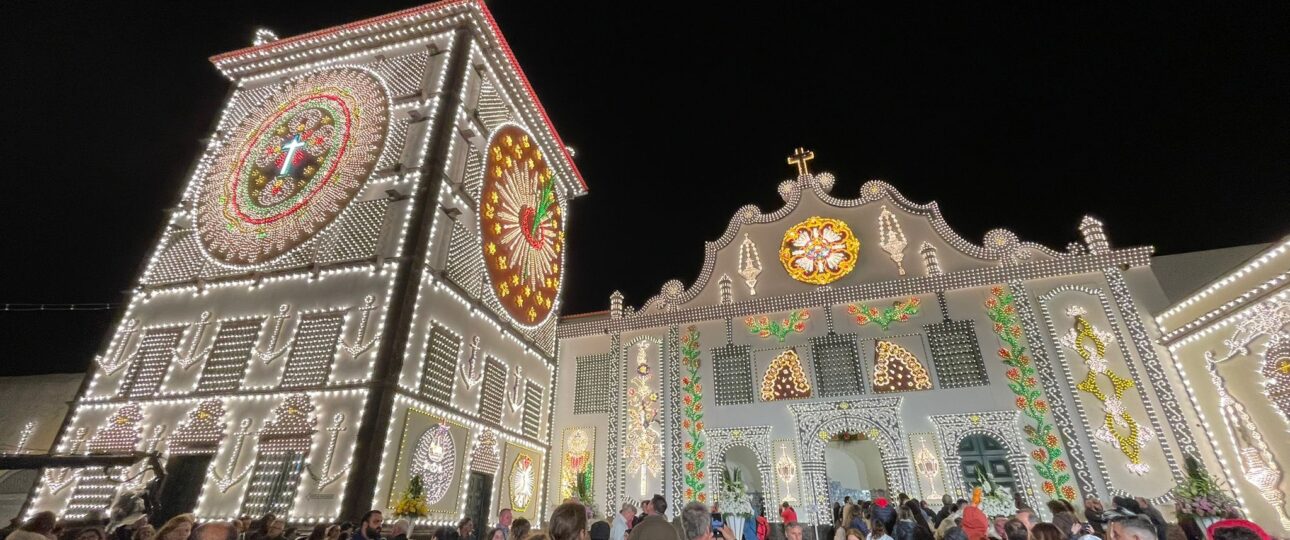
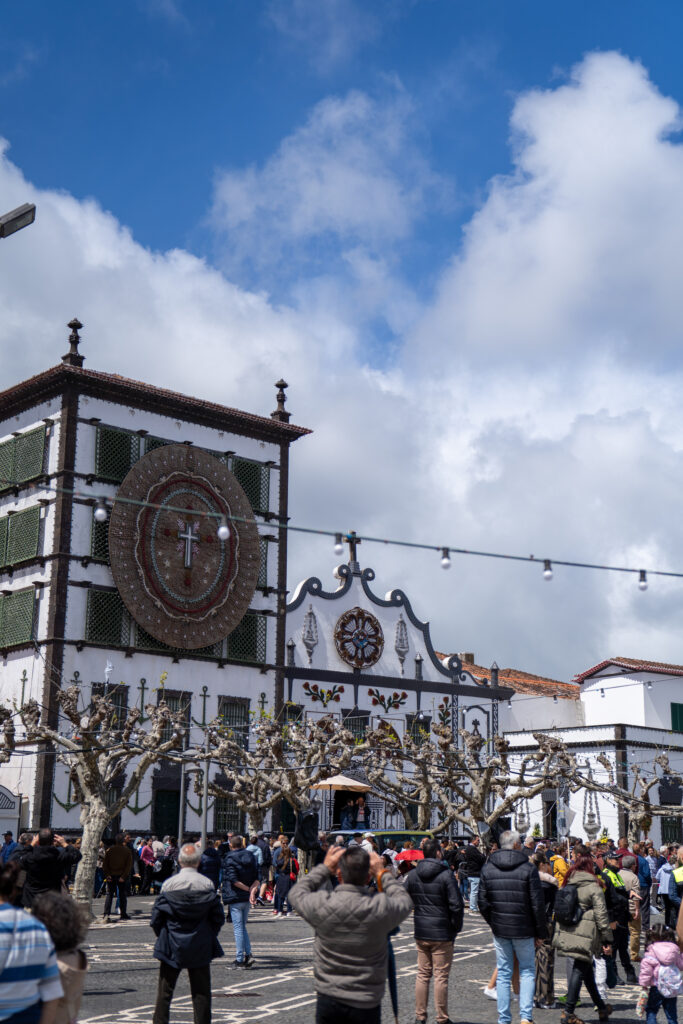
On the Friday night of the festival, the Campo de São Francisco is illuminated by hundreds of thousands of blue and white bulbs. When the lights flicker on for the first time, the collective “ooh” from the crowd is a moment of pure magic.
The Flower Carpets
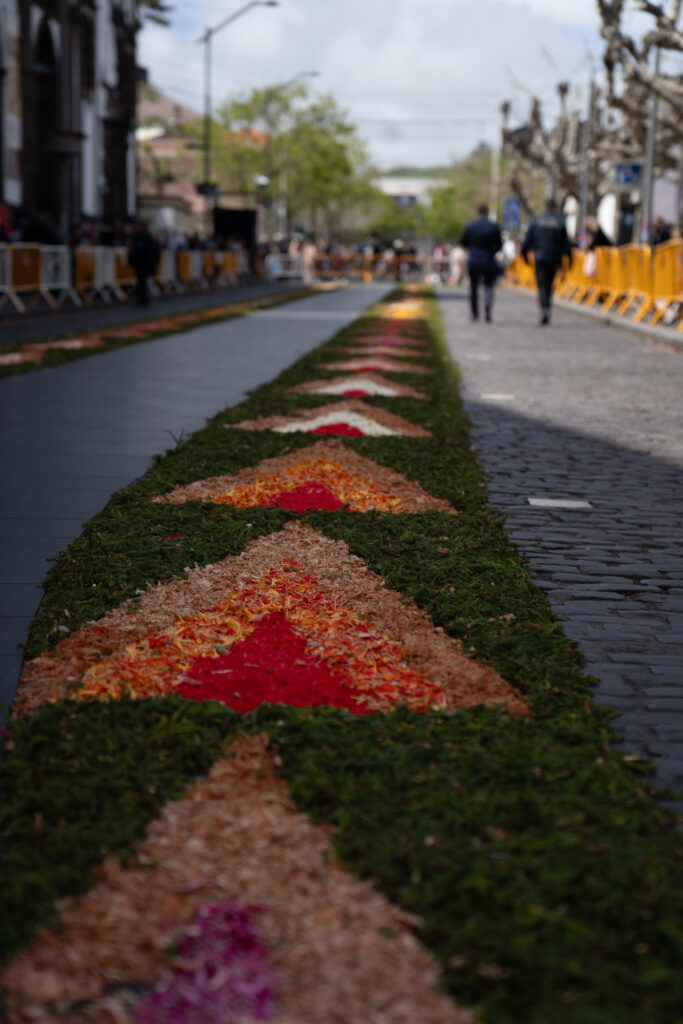
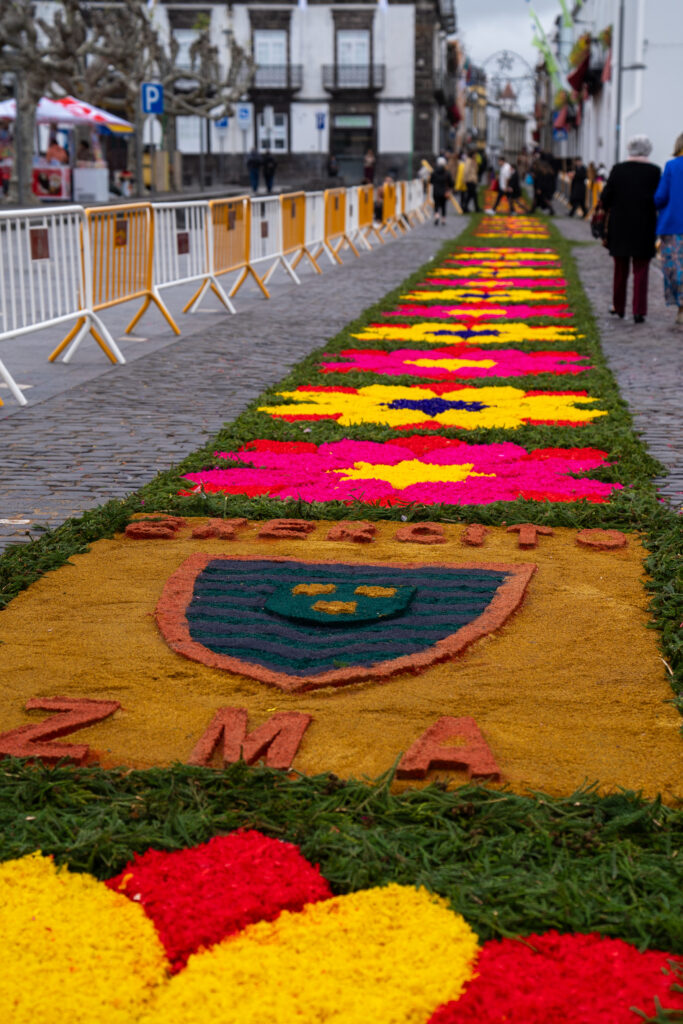
By Saturday and sunday morning, the streets of the city center are covered in “Flower Carpets” (Tapetes de Flores). Local families stay up all night using volcanic sand, dyed sawdust, and thousands of petals to create geometric patterns that the procession will later walk over.
The Flavor of the Festival
You cannot experience Santo Cristo without eating!
Malassadas: Azorean fried dough coated in sugar.
Bolo Lêvedo: Warm local bread with garlic butter.
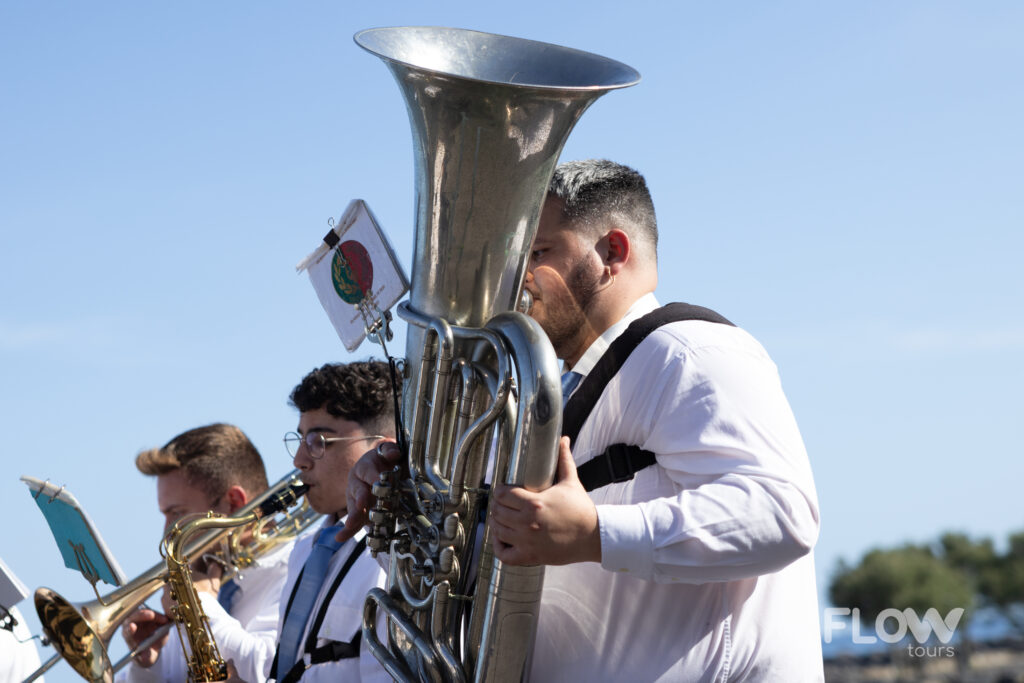
The Arraial: Join the locals for wine and grilled limpets while listening to traditional philharmonic bands.
The Sunday Procession: A Sea of Faith and Flame
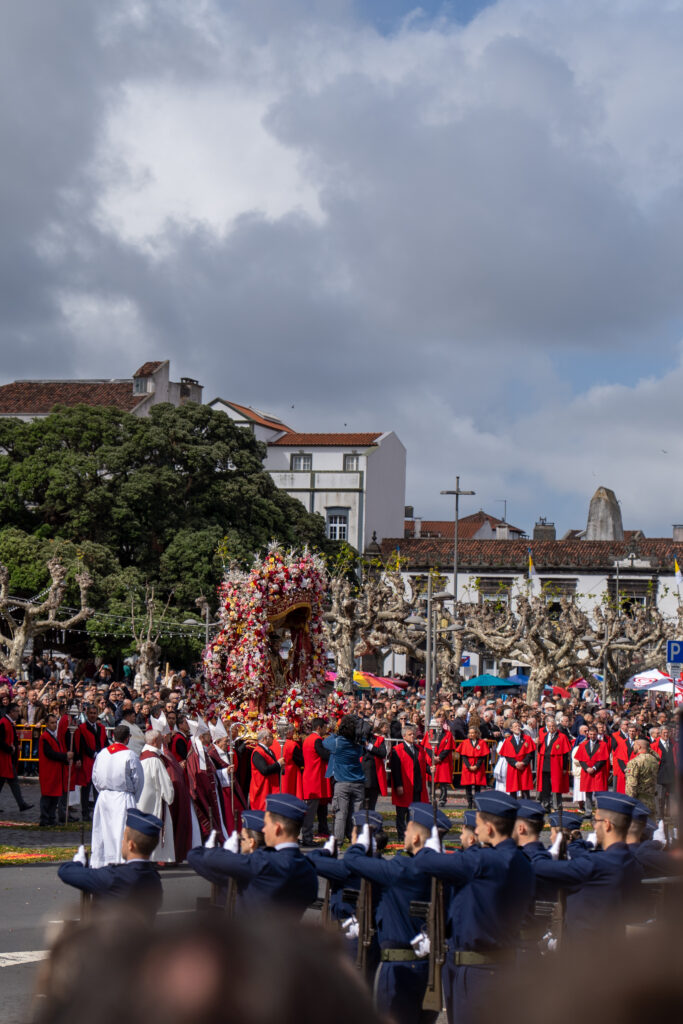
If the lights represent the joy of the festival, the Sunday Procession represents its soul. For hours, the streets of Ponta Delgada become a river of people, but the most striking sight is the thousands of devoted pilgrims who walk the entire route—often kilometers/miles long—carrying massive wax candles.
The “Promessas”: Why They Carry the Wax
For many, this isn’t just a walk; it’s a physical manifestation of a “promessa” (a vow). In moments of deep crisis—a failing health report, a family tragedy, or a desperate hope—devotees make a pact with the Lord. If their prayer is answered, they commit to walking the procession.
The Big Candles: You will see men, women, and even children carrying candles (ciriais) that are sometimes as tall and heavy as themselves. These candles represent the “light” of their prayer.
Walking Barefoot: To show true humility and penance, many pilgrims discard their shoes, walking the rough, volcanic cobblestones and the petal-strewn streets barefoot for the duration of the five-hour event.
The Kneeling Devotees: The most moving—and heartbreaking—sight is the pilgrims who traverse the entire perimeter of the Campo de São Francisco on their knees, often supported by family members who lay jackets or cardboard down to protect them from the jagged stones.
The Rhythm of the March
The procession is a masterpiece of organized chaos and deep silence.
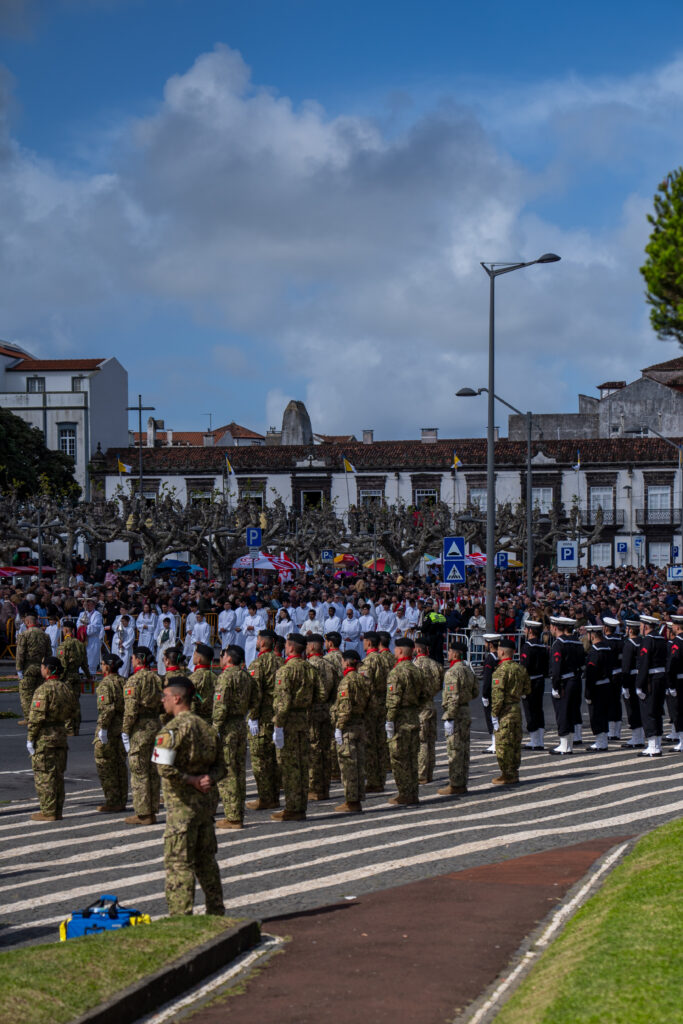
The Philharmonic Bands: Dozens of brass bands from every corner of the island (and even from the US and Canada) provide a somber, rhythmic soundtrack that echoes off the city walls.
The Brotherhoods: Men dressed in traditional colorful capes (opas) lead the way, representing the various religious brotherhoods of the Azores.
The Flower Carpets: The pilgrims walk directly over the intricate flower carpets created the night before. By the end of the day, the petals are crushed into the ground, their scent releasing into the air under the weight of thousands of feet.
A Shared Burden
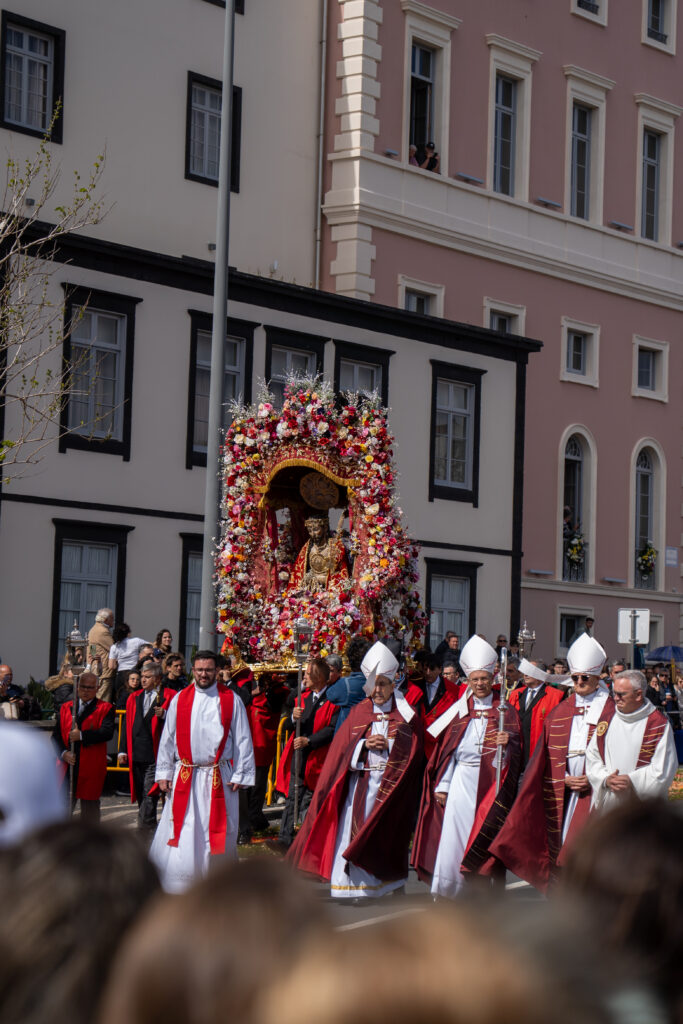
The image itself is carried on a massive, ornate wooden litter adorned with silver and thousands of fresh flowers. It is incredibly heavy, and being a “bearer” of the Lord is considered one of the highest honors an Azorean man can receive. They rotate frequently, sweat pouring down their faces, symbolizing the “shared burden” of the community’s faith.
Flowtours Insight: If you are watching from the sidelines, the atmosphere is electric. It is common to see people weeping as the image passes by. Even if you aren’t religious, the sheer magnitude of human emotion and collective devotion is enough to give anyone goosebumps. It is a powerful reminder of the resilience and spirit of the Azorean people.
Don’t Miss the Moment
Watching the flickering flames of thousands of candles as the sun begins to set over the Ponta Delgada harbor is an image you will never forget.
The 2026 Festivities: A Day-by-Day Guide
To experience Santo Cristo dos Milagres like a true Azorean, you need to know the rhythm of the week. While the faith is deep, the celebration is vast, spanning over a week of events that mix the sacred with the spectacular.
Here is the “Step-by-Step” schedule so you can plan your future pilgrimage.
Friday: The Night of a Million Lights
The Moment: At precisely 9:00 PM, the Campo de São Francisco falls silent. Then, with the flip of a switch, the entire façade of the Sanctuary and the surrounding square erupts into a sea of blue and white decorative lights.
The Experience: This marks the official “Opening of the Bazaar.” Philharmonic bands play the “Hymn of Santo Cristo,” and the city officially begins its street festival (Arraial).
Pro Tip: This is the best night to eat your first malasada and enjoy the carnival atmosphere before the crowds become truly massive.
Saturday: The “Mudança” (The Moving of the Image)
The Exit: At 4:30 PM, the image of Santo Cristo makes its first appearance. It is moved from its high altar in the Esperança Convent to the Church of São José.
The Military Salute: As the image crosses the threshold of the “Regral Door,” the bells of every church in the city ring out, and a naval corvette in the harbor fires a thunderous salute.
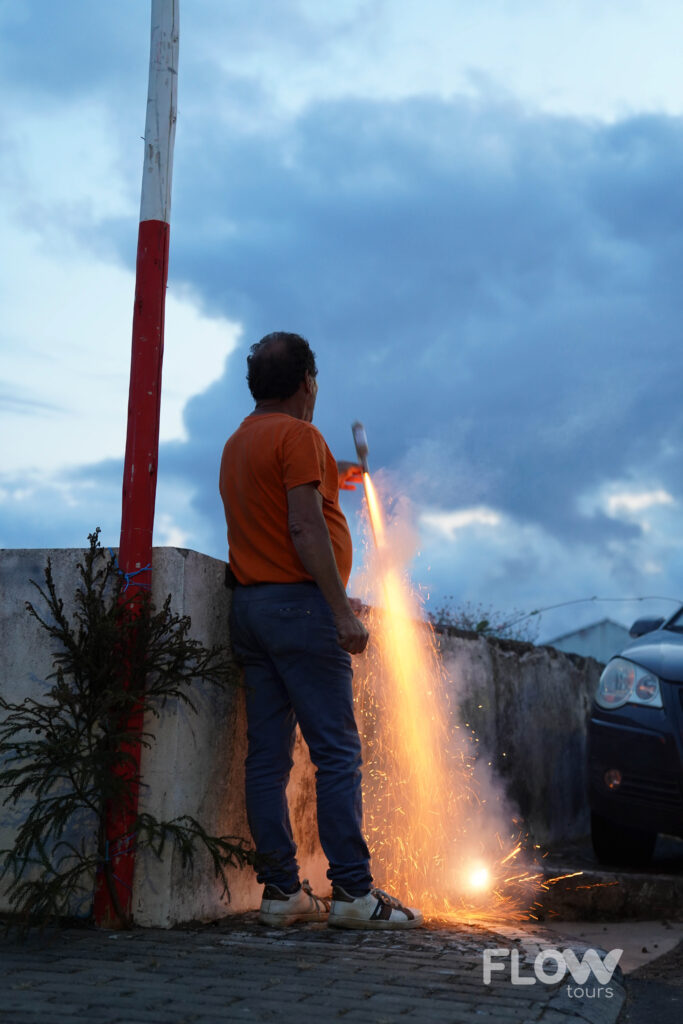
The Fireworks: At 10:30 PM, look toward the harbor wall (Muralha da Doca). A massive fireworks display paints the Atlantic sky, celebrating the Lord’s presence in the city streets.
Sunday: The Grand Procession (The Main Event)
The Morning: The city wakes up to the sound of mortar salutes at 6:00 AM. Masses are held throughout the morning (including a specific Mass for English-speaking pilgrims at 8:00 AM).
The Procession Begins: At 3:30 PM, the “Guião” (the procession banner) leaves, and at 4:30 PM, the image begins its five-hour journey through the historic center.
The Route: Thousands of pilgrims walk barefoot, carrying their tall wax candles, while the image moves over the miles of hand-laid flower carpets.
The Return: The image returns to its sanctuary late in the evening (usually around 10:00 PM), marking the spiritual peak of the year.
Monday: The Day of the Diaspora
The Celebration: Monday is traditionally for the locals and returning emigrants.
The “Cantigas ao Desafio”: Head to the main stage in the afternoon (around 2:00 PM) to hear traditional improvised folk singing duels—a witty, fast-paced Azorean musical tradition.
The Motobikes, police & Taxi Parade: One of the most unique “modern” traditions! A massive parade of decorated cars and taxis winds through the city, honking their horns and carrying floral tributes to the Lord, representing the “workers” of the island.
A Note for Future Travelers
The dates of the festival change every year because it is tied to Easter (the 5th Sunday after Easter Sunday). If you are planning for 2027 or beyond, ensure you check the liturgical calendar or contact us at Flowtours to synchronize your flights with these specific moments.
Insider Tips for 2026 and 2027
Book Early: Hotels in Ponta Delgada for the “Fifth Sunday after Easter” (the festival date) often sell out a year in advance.
The Best View: For the Sunday procession, find a spot near the Portas da Cidade (City Gates) or secure a balcony spot if you know a local!
Look Up: Observe the balconies of the old houses. They are draped in red damask bedspreads—a centuries-old tradition to welcome the “Lord of the Miracles.”
Dress Code: If you plan on entering the Convent, ensure your shoulders are covered. For the street party, wear your most comfortable walking shoes—you will be on your feet for hours.
Conclusion
The Legacy Continues: Why You Must Witness It
The festivities of Senhor Santo Cristo dos Milagres are a rare window into the soul of the Azores. It is a time when the boundaries between the past and the present blur—where 17th-century traditions meet the vibrant energy of a modern island celebration. Whether you find yourself moved by the silent, tearful devotion of the pilgrims or swept up in the laughter and music of the crowded squares, one thing is certain: you will leave São Miguel feeling differently than when you arrived.
At Flowtours, we don’t just want to show you the sights; we want you to feel the weight of the gold, the scent of the incense, and the warmth of the Azorean people. This isn’t just a festival on a calendar—it is a living, breathing miracle that defines what it means to be from these islands.
The lights are waiting to be dimmed, the flowers are ready to be laid, and the “Lord of the Miracles” is prepared for his journey. Will you be there to see it?
Experience the Azores with Flowtours
Ready to witness the largest cultural event in the Mid-Atlantic? At Flowtours, we specialize in immersive Azorean experiences that go beyond the guidebook. From private historical walks during the festival to hidden trail hikes once the crowds disperse, we make your journey unforgettable.

Filipe Pedro
Olá! I'm Filipe, your dedicated guide to the enchanting Azores. Born and raised on these captivating islands, I've spent over 14 years immersed in the tourism industry, sharing the magic of Portugal with visitors from around the globe.


